What Raw Footage Signals an AI Agent Actually Reads Before Making Its First Cut
Better inputs and targeted human review produce stronger first cuts than automation alone.
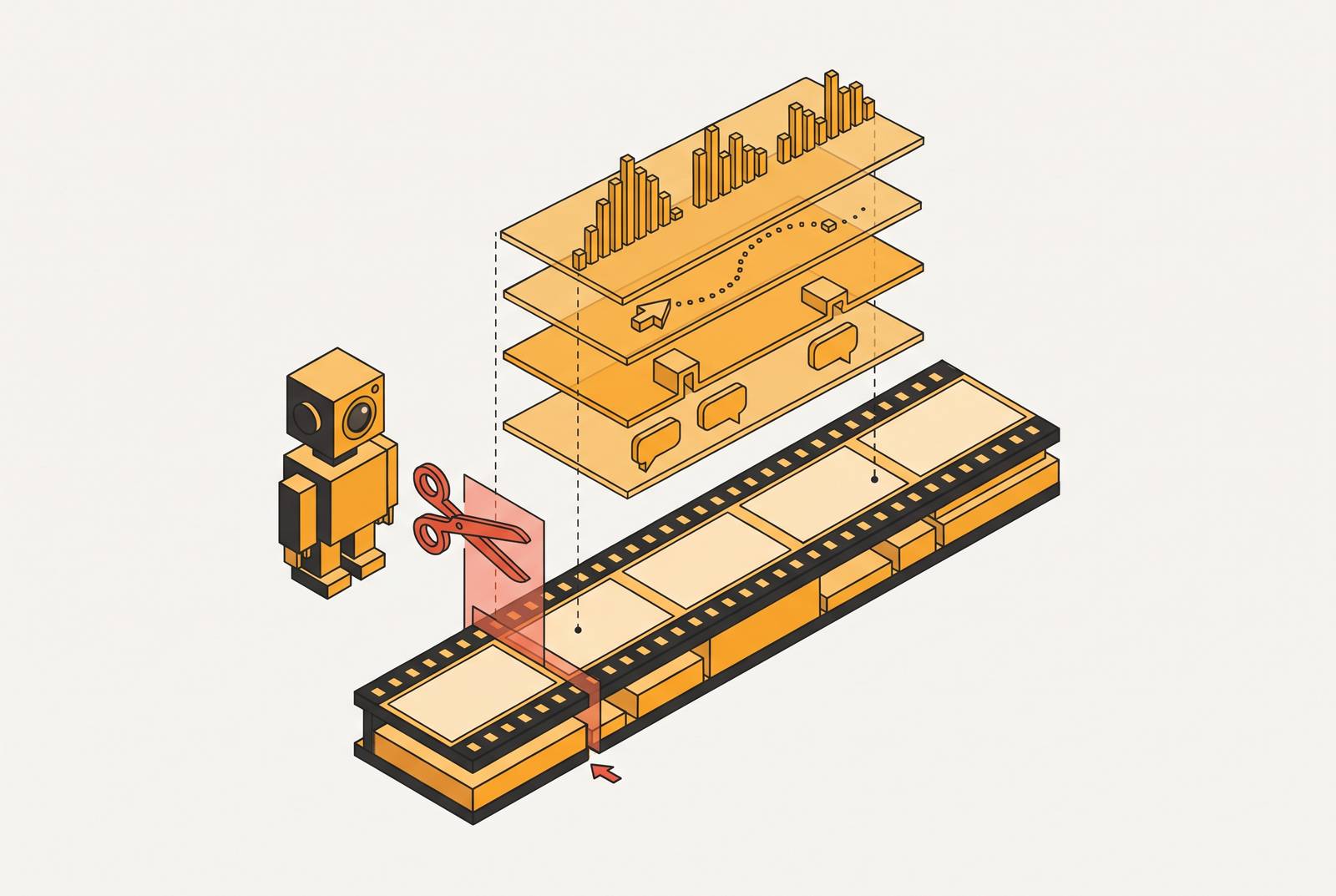
Agentic video editing means an AI agent reads raw footage, weighs its signals against an editorial goal, and makes decisions about cuts and pacing. Those signals include visual quality, motion, audio, facial engagement, and screen content. Understanding what the agent reads explains its choices, and why better inputs and targeted human review do more for the first cut than automation alone.
Why AI agents need to read footage before they can cut it
First-generation AI video tools matched patterns. Face detection found faces, and object recognition found objects, but neither could tell whether a moment should be in the edit. An agent works toward an objective instead, such as finding the best interview moment where the CEO discusses the company’s mission with genuine enthusiasm. That requires a judgment about relevance and performance.
The distinction is between finding footage and choosing it. A clip can contain the right person and still contribute nothing to the story. Before an agent can decide what to remove, it needs some basis for deciding what is useful. The way it reads the footage gives it that basis and makes its choices easier to understand and question.
How the agent sees individual frames before it thinks about sequences
Modern vision models read frames through deep neural networks trained on vast image datasets to pick out low-level features such as edges, textures, and color gradients. Those features support recognition of shapes, objects, and spatial relationships. At a higher level, the models recognize scenes, activities, and compositional patterns. This is the visual inventory, before the editorial argument begins.
Object detection identifies discrete objects and locates them within the image, enabling queries for shots where the product appears in the lower third. Face analysis estimates expression, gaze direction, and whether something obscures a face. When reference images are provided, it can also identify specific individuals. Those identity signals support A-cam/B-cam matching based on who is speaking, while scene classification groups footage into settings such as an office, park, or studio.
Composition adds another set of usable labels. The agent assesses whether a shot is wide, medium, or close-up, together with camera angle and depth of field. That metadata supports continuity checking and sequence assembly. Technical scoring separately evaluates focus, exposure, motion blur, and noise, helping determine which clips receive priority review and which are deprioritized.
What temporal analysis adds once the agent compares frames across time
A frame shows a position. Comparing consecutive frames reveals camera movement, including pans, tilts, dolly moves, and zooms, as well as subjects walking, gesturing, or leaving the image. A static interview therefore has a different motion signature from a handheld documentary shot. The agent uses that difference to classify footage and assess how it might serve an edit.
The analysis also operates over longer stretches. At the shot level, measured in seconds, it detects existing cuts or natural transitions in raw recordings, dividing continuous footage into clips it can assess individually. At the scene level, measured in minutes, it reads the arc of a conversation or the build and release of an action sequence. That wider view supports pacing decisions because a moment’s role depends partly on what surrounds it.
Project-level analysis expands the view to all the footage. It can track narrative threads, character development across interview sessions, and thematic connections between otherwise separate clips. For a team recording a product demonstration, temporal analysis also helps distinguish deliberate workflow steps from cursor drift or accidental repetition. Motion is not just activity. It can be evidence of intent.
Why the audio layer is the most consequential signal the agent reads
Audio quality gates transcription accuracy, which underpins transcript-based editing, filler detection, chapter segmentation, and content scoring. Clean studio recordings support high accuracy, while moderately noisy recordings can erode it rapidly. Every feature that relies on the transcript inherits its errors. The reasoning layer cannot score the meaning of a sentence accurately if the words arriving there are wrong.
Before that reasoning begins, audio analysis flags clipping, hum, wind noise, background chatter, and room echo. These warnings identify clips that need post-processing or may be unusable. Silence removal also depends directly on the sound signal, using a loudness threshold and minimum duration to propose cuts for review. If background noise sits at or above the silence floor, the system can miss genuine pauses, leave dead air, or cut into live speech. Room hum makes a poor editing assistant.
PowerCut AI uses Whisper for transcription and language models to score segments by shareability, clarity, and narrative completeness. That dependency puts microphone quality upstream of AI capability. In screen recordings, narration captured over system noise or through a laptop microphone in a reverberant room similarly weakens transcription, narration generation, silence removal, and captions. Speak clearly, leave brief pauses between major points, and treat the microphone as an editorial tool.
How the agent reads facial expression and speaker engagement
Models estimate emotional states frame by frame, tracking changes in expression that correlate with engagement, hesitation, or emphasis. Gaze and eye contact serve as proxies for camera presence, so a speaker looking into the lens scores differently from someone reading notes off-screen. In parallel, audio sentiment analysis reads speech pace, filler frequency, vocal energy, and word choice. The agent combines these signals to estimate whether a moment will connect with an audience.
A proxy is not a verdict, however. Combined take-quality assessment is meaningfully less reliable than transcription, making this layer especially dependent on human calibration. A low-engagement flag can make sense given the signals the agent has, yet still be the wrong editorial call. Understanding that reading lets a creator agree, override it with reason, or recognize that the performance itself needs to change.
What the agent does with screen content as a distinct signal class
For SaaS teams, educators, and async communicators, the significant details include the active application, buttons clicked, cursor behavior, and workflow steps demonstrated. The agent reads those details as a signal class of their own rather than seeing the recording as an oddly rectangular landscape. That reading enables content-aware editing without manual annotation.
Tools can use the screen activity to produce a description that stays synced with the video, with the creator reviewing and editing the script as text before voice generation. Smart zoom and callouts use the same underlying information. Click targets and interface interactions become points of emphasis, rather than excuses to zoom uniformly across the timeline.
This signal is vulnerable to clutter and change. Low resolution, a fast-moving cursor, and background applications left on-screen can make the workflow harder for the agent to see or understand. A later interface change creates a different problem, because narration and annotations that were accurate when recorded can become wrong. Reusable scenes and simple review workflows address that content decay more directly than more sophisticated AI.
How the agent synthesizes all five signal layers into a first cut decision
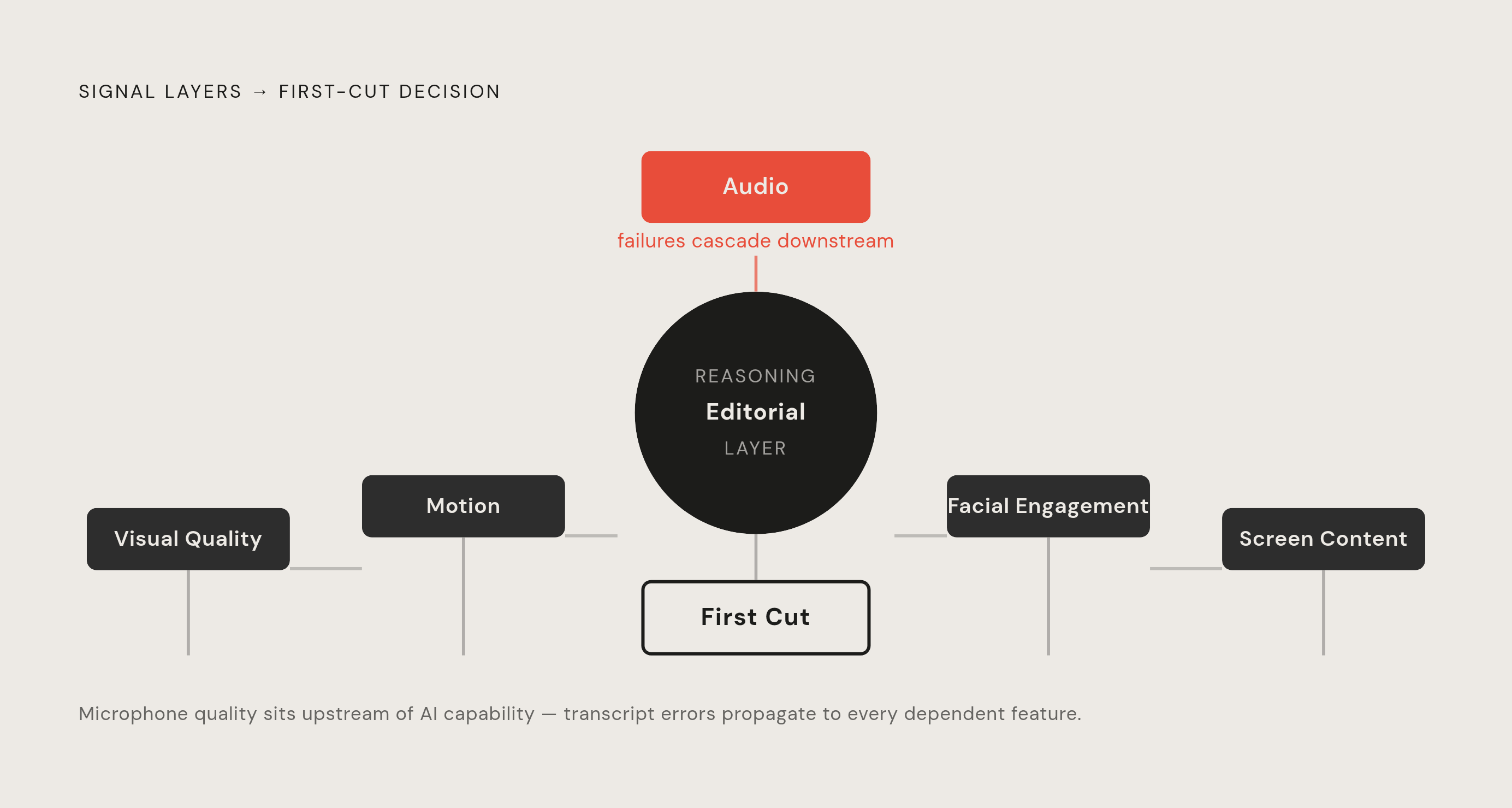
The first cut emerges from weighing signals together. Visual quality, motion, audio, facial engagement, and screen content feed a reasoning layer that evaluates footage against an editorial objective. This is what separates an agent from a collection of detectors. Detecting blur tells the agent it is there. Deciding whether to keep a blurred take means weighing the blur against other signals.
Consider a take with a correct transcription and strong facial engagement but motion blur that is easy to see. The technical signal argues against it, while the content and performance signals argue for keeping it. The agent must weigh whether the value of the moment justifies the flaw, much as a human editor decides whether to work around a camera problem.
Shareability scoring also draws on this combined reading. The agent evaluates candidates against patterns from successful content, looking for hooks, emotional beats, and narrative completeness. Once it decides what to keep, it can execute format changes such as horizontal-to-vertical reframing, caption repositioning, and trimming to platform-optimal duration. Its perceive, plan, act loop then revisits the output against the original objective. That loop lets the agent make several cuts from the same footage, so the creator can compare versions.
Where AI signal reading reliably succeeds and where it still needs human override
Transcription on clean audio and technical quality scoring are strong, while shot boundary detection and silence removal are well-established when the relevant signals are clear. These tasks ask fairly concrete questions about what is in the recording. Take selection asks the harder question of whether to keep a performance, and human editors are still better at creative story structure, emotional pacing, and changes to suit a client.
An arXiv preprint submitted to ACM compared agentic AI-edited video recaps with human-edited recaps and found that the agentic pipeline rated substantially lower on editing professionalism. Genre alignment and watchability were rated comparably. The distinction is important because it locates the shortfall in judgment-intensive editing rather than showing that the generated videos were simply unwatchable. The paper’s peer-review status is unconfirmed, and its findings concern the recap comparison it studied.
The agent can eliminate obvious rejects, surface likely keepers, and handle mechanical work such as silence removal, captions, and format compliance. Human review should concentrate on take selection, story structure, and pacing, where a plausible score is not enough to settle the decision.
What creators should control in raw footage to give the agent better signals to read
For creators, the lesson is to improve the evidence before asking the agent to judge it. Audio comes first because a clean microphone signal benefits several downstream features at once. Soft frontal light, steady exposure, and a stable camera frame then cut down on the technical problems that can lead the agent to reject otherwise useful footage. These choices give the agent fewer defects to weigh against the value of the content.
Brief pauses between major points provide clear boundaries, while rapid, unbroken delivery leaves chapter and clip detection with less distinct transitions to read. Eye contact and changes in vocal energy likewise give the engagement layer clearer differences between moments. A flat, eyes-down delivery compresses those differences and makes suggested takes harder to distinguish.
Screen recordings need equally deliberate visual inputs. Sufficient resolution, slower cursor movement at key interactions, and closed background applications help the agent read the intended workflow for narration, smart zoom, and annotation. These adjustments make the original recording clearer and its eventual revision easier to manage through reusable scenes and a simple review process, with review remaining necessary particularly when the interface later changes.
Recording choices determine what the agent can infer, while review determines which inferences deserve to shape the final video. The workflow should connect clear capture, a signal-informed first cut, and focused human review in one place.