Evaluating AI Video Edit Quality Without Manual Review
Three measurable signals can flag publish-ready edits and route doubtful ones to people.

To judge AI video edit quality without manual review, use temporal consistency, instruction compliance, and semantic fidelity to check whether an edit is ready to publish. For agentic video editing, teams can automate the checks they can measure and send cases they are unsure about to people, who then have fewer exports to watch. Editing videos with AI removes timeline work only to replace it with a review queue unless evaluation is part of the workflow.
Why automated evaluation has become necessary for AI-edited video
AI-assisted editing has outpaced the quality-control processes teams use to approve its output. The edit may finish quickly, but someone still has to watch it, spot mistakes, and decide whether they need fixing before it can be published. That queue becomes the production bottleneck. Manual review is also inconsistent across reviewers, so adding people does not automatically create a dependable standard. The timeline has been automated, but the waiting room has not.
Publishing velocity is therefore a more useful KPI than hours saved inside an editing tool. An export that sits awaiting approval has not yet delivered the speed advantage AI editing promises. Teams that evaluate and publish faster can compound their output advantage, provided their checks catch the errors that would otherwise reach viewers. Teams need to identify signals that reliably predict publish-readiness and apply them without a person watching the whole video.
What automated metrics actually measure — and what they miss
Automated metrics measure parts of video quality. Frame-to-frame embedding similarity uses DINO or CLIP to compare visual representations, while optical-flow consistency and motion smoothness check how things behave from frame to frame. These measures help catch flicker, jitter, and discontinuity. They do not establish that an edit followed its instructions or preserved the meaning of a walkthrough. A smooth mistake is still a mistake.
Instruction checks look at a different relationship, which is the match between the request and the output. CLIP/VideoCLIP alignment can measure broad correspondence, while multimodal large language model judges, or MLLM judges, can answer more specific checklist questions. CoVEBench’s 2026 benchmark includes 9,990 fine-grained checklist items for diagnostic video editing evaluation. Its Video Quality dimension separately scores motion smoothness (MSM), technical quality (TQ), and aesthetics (AES). That separation is useful because looking good and doing the job are different tests.
Semantic fidelity is harder to reduce to a score. It asks whether the edited content remains logically and visually plausible in context, which requires a capable vision-language model or a human. The CVPR 2023 TGVE Competition organizers found automated metrics quite noisy and human evaluation more trustworthy, a finding that has not been conclusively overturned. Fine-grained scene entity alignment, spatiotemporal consistency, and visual quality in motion remain difficult for MLLM-based evaluation. The implication is not to abandon automation, but to choose signals according to the failures they can actually detect.
Three signal categories that together predict publish-readiness
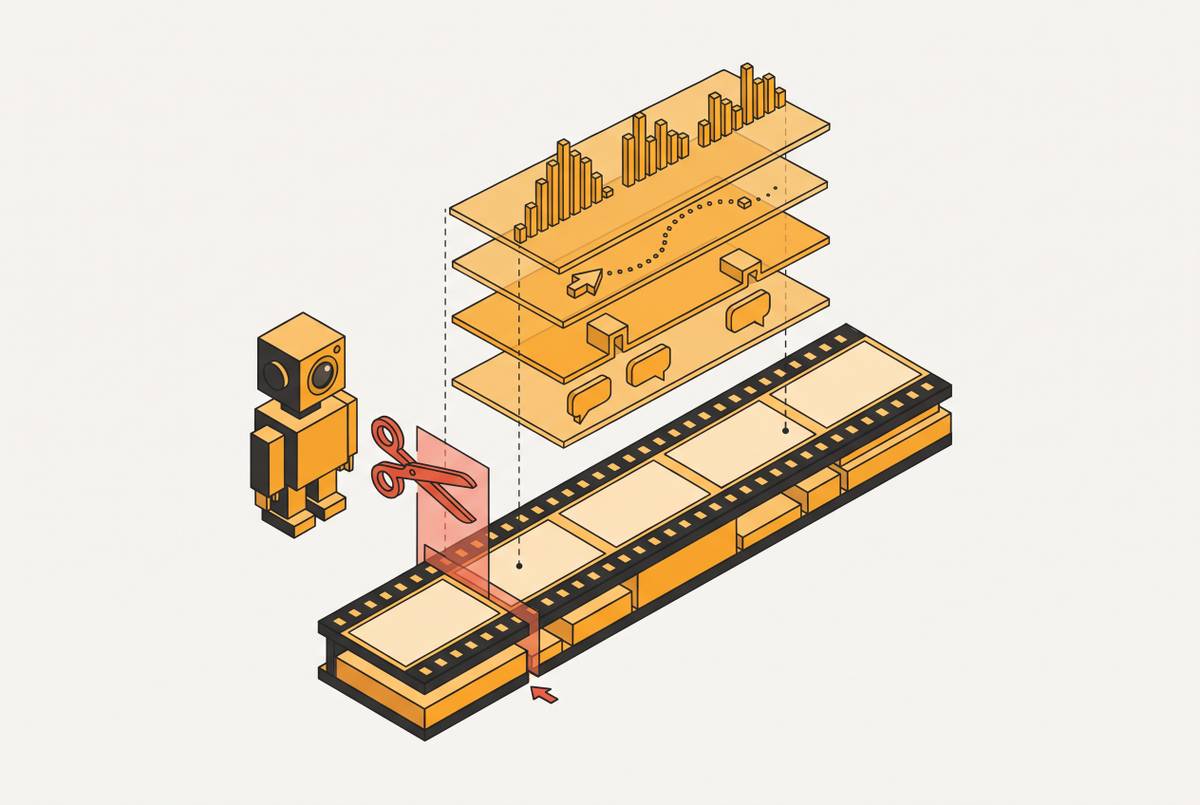
Temporal consistency belongs in the working set because video unfolds over time. A frame can look acceptable on its own while the sequence flickers, drifts, or jumps between incompatible states. Frame-level embedding similarity, optical-flow consistency, and motion smoothness are established, computationally tractable ways to detect these failures without a reference edit. CoVEBench gives motion smoothness an explicit place in its quality assessment. For screen recordings, this category also catches visible rendering gaps where a transition between steps is abrupt or incomplete.
Instruction compliance belongs because a successful run is not proof of a successful edit. A global CLIP score can look favorable even when a compositional prompt has been only partly fulfilled. An average can hide a request that was missed. Breaking the instruction into atomic checklist items makes completion auditable. In a product demo or onboarding walkthrough, that distinction reaches the viewer directly when a required step is skipped or shown out of order.
CoVEBench introduces Union Accuracy (UAS) to make the combined judgment strict. A task scores 1 only when its MLLM judge, Qwen3.5-A10B, answers both the instruction-following and realism questions correctly, while partial completion scores 0. This prevents a correct change from compensating for an unrealistic result. The two requirements must hold together. For production evaluation, the useful principle is that an edit should not pass merely because it completed the easiest part of the request.
Semantic fidelity adds the context those checks can miss. It asks whether the change makes sense, whether modified regions remain plausible, and whether unrelated content has been preserved. A requested object can be present yet wrong in context. CoVEBench uses its judge to assess these questions, extending evaluation beyond the presence of the requested change. This category is necessary because compliance can establish that something happened without establishing that the resulting video is coherent.
EditVerse, from Adobe Research, The Chinese University of Hong Kong, and Johns Hopkins University, illustrates why semantic evaluation still needs mixed evidence. Its unified model is tested on EditVerseBench with a range of instruction-based video editing tasks and resolutions, using both user studies and automated metrics. Human judgment remains part of that assessment. For automated judges, narrow questions about whether an object is present or a region remains unchanged are more dependable than a sweeping request to rate realism. Semantic fidelity is a working category.
It measures aesthetic quality through the LAION aesthetic predictor, which uses CLIP + MLP, and background consistency through CLIP. It measures dynamic degree with RAFT optical flow and imaging quality with MUSIQ trained on SPAQ. VBench’s frame interpolation model measures motion smoothness, while cross-frame comparison measures subject consistency. These measures have distinct jobs. The background and subject checks catch drift in scenery or appearance that a broad quality score could hide.
The framework’s annotation pipeline combines automated retrieval of reference examples with DeepSeek’s direct video analysis to assign dimension-level scores at scale. This saves people from having to score thousands of videos by hand. It also separates motion, appearance, and image quality rather than treating them as interchangeable evidence. Its scope still needs care, however. Caption-to-video alignment is imperfect, and the framework was designed for generative video rather than screen-recording-based product content, where a readable button label may be more important than an attractive background.
Why screen-recording video has failure modes that general benchmarks underserve
Product demos and SaaS onboarding videos earn their value through precision. The same is true of tutorials, internal documentation, and customer success videos, where viewers need to understand a sequence well enough to follow it. UI text, button labels, and feature names must remain legible and accurately transcribed. A blurred label can make the whole explanation fail. A video that looks polished does little good when the viewer cannot tell which button to press.
Scene cuts also have a different role in these videos. A misplaced cut in a landscape shot can interrupt its appearance, while a cut in the middle of a workflow can remove the action that explains the next screen. The sequence loses its logical thread. Temporal consistency therefore has to include workflow continuity alongside smooth movement between neighboring frames. A transition can look immaculate while skipping the step the viewer came to learn.
This difference becomes clearer when compared with avatar-generated video. Lip-sync alignment and avatar realism matter most there, while screen recordings rely heavily on UI text legibility and transcript accuracy. Different failures require different tests. For audiences around the world, translated caption tracks also need to be accurate because many SaaS buyers are non-native English speakers. Checking only the source-language transcript leaves that part of the viewing experience unevaluated.
General benchmarks can still help catch visual flaws, but more checks are needed to decide whether this content is ready to publish. Background drift and motion artifacts warrant checks alongside those for a misread feature name, a missing action, or an inaccurate translated caption. The evaluation must follow the viewer’s task.
Where MLLM judges work and where they still require a human in the loop
The objection that MLLM judges are unreliable is valid when it treats reliability as dependent on the task. A narrow binary question asks the judge to check one condition, while an open-ended quality rating asks it to make many judgments with no clear limit. The question changes the difficulty of the job. CoVEBench’s atomic checks give the judge a more constrained decision than asking whether a whole video looks professional.
Within an automated pipeline, temporal consistency scoring, scene-cut F1, background consistency, and binary compliance checks on atomic edits are suitable decisions for automation. Those checks do not all require an MLLM. Dedicated metrics can handle visual signals, leaving the language-and-vision judge to assess scoped instruction questions. Each decision has a defined basis.
Human review remains necessary for holistic realism, fine-grained spatiotemporal coherence, and correctness that depends on domain knowledge the judge lacks. A specific product’s UI is one such case. A model may know that it sees a button without knowing whether that button is right for the product being taught. Confidence in visual recognition is not the same as product knowledge. When the criterion falls outside the judge’s competence, an apparently favorable answer cannot settle publication.
In practice, automation clears the volume by identifying measurable failures and routing unresolved cases for review. People then handle the judgments the system cannot classify confidently. “Without manual review” is a workable goal for routine edits.
A practical evaluation workflow that applies these signals before publication
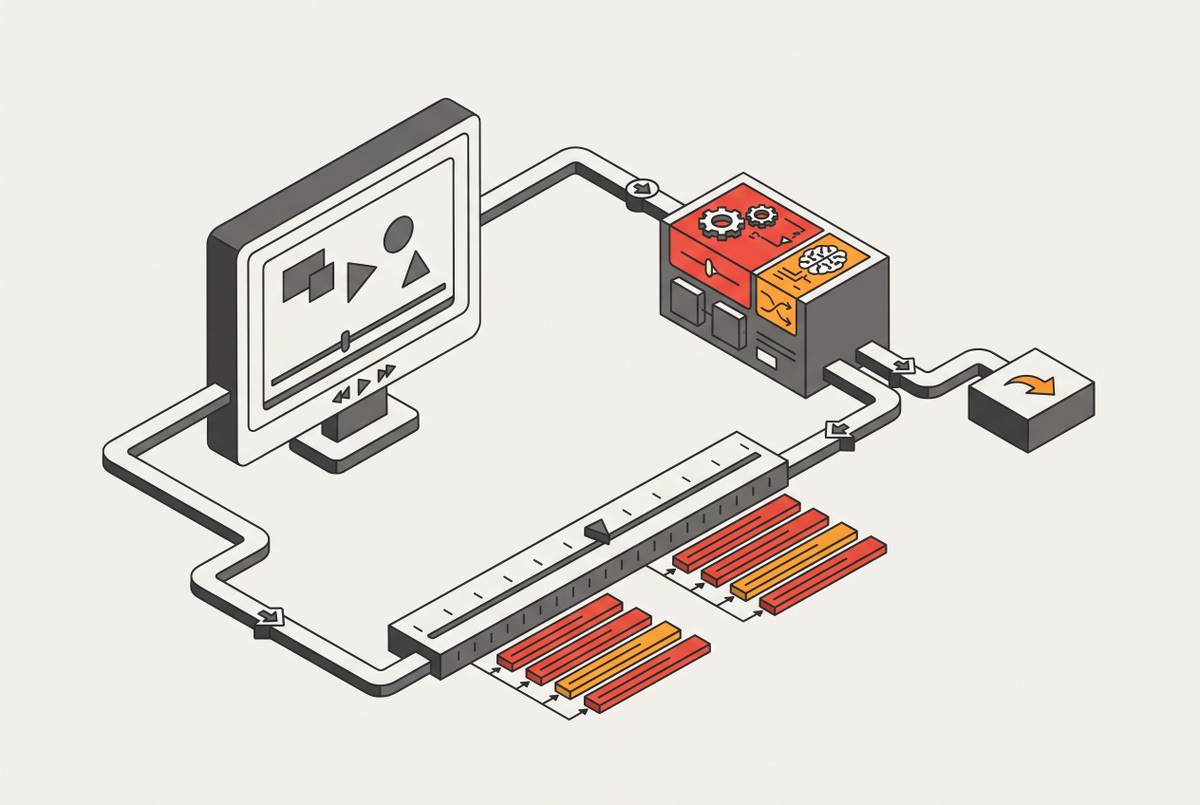
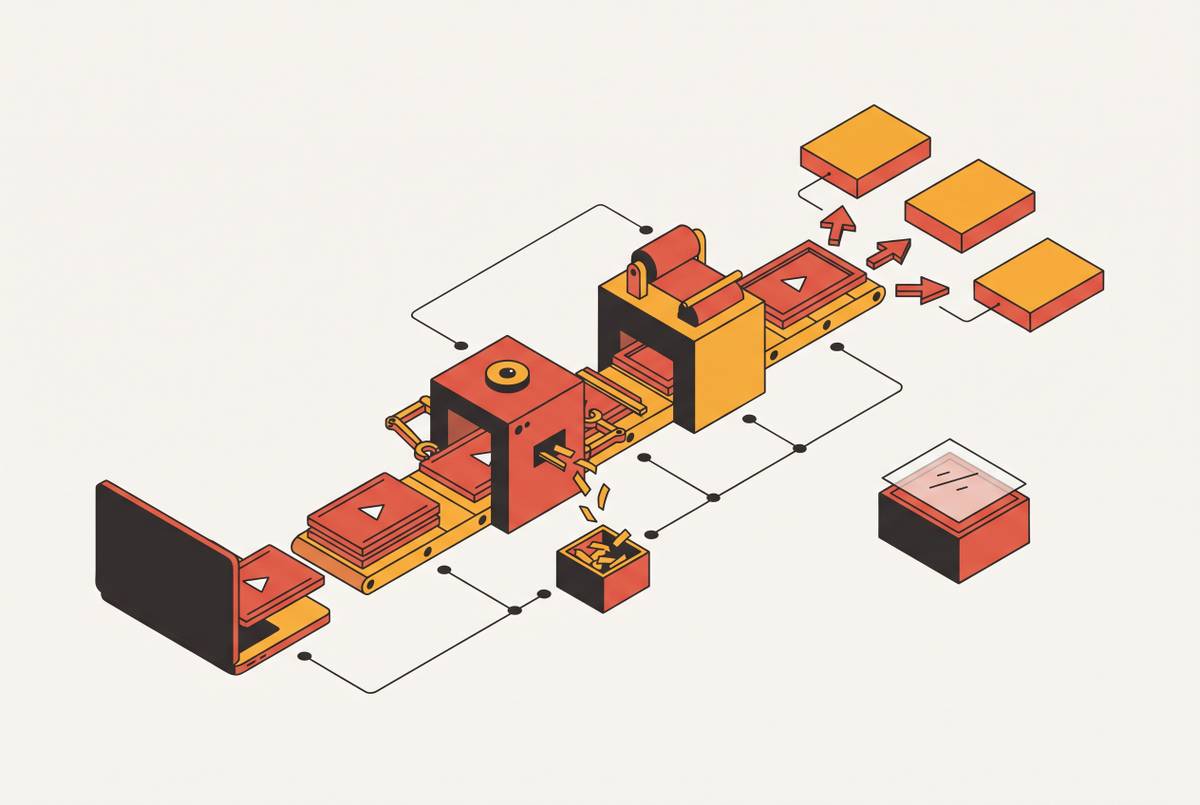
To put that boundary into practice, a team should layer evaluation by cost and sensitivity. Cheap automated checks run on every edited video first, followed by MLLM-judged compliance on those that pass. People review only the flagged cases. This order avoids spending the most demanding review effort on videos with readily detectable problems. It also gives each stage a clear reason to stop an edit from proceeding.
The first layer should check temporal consistency through frame-to-frame embedding similarity and motion smoothness, flagging below-threshold videos for review. Caption word error rate should be checked with the product or domain terminology list, with named-feature and UI-label errors automatically flagged. Scene-cut F1 should check whether cuts fall where one workflow step ends and another begins, or cut an action short. CLIP-based cross-frame comparison should flag background and subject drift in regions that were left unedited.
Videos that pass should move to the instruction-compliance layer. Following the CoVEBench pattern, the team should break the edit request into atomic checklist items and score each as a binary decision. Every required edit must pass. Applying Union Accuracy logic means partial compliance produces a flag rather than an approval, while realism remains a required part of the judgment. Questions should stay narrow, asking whether a given UI element can be seen in a given frame.
Only flagged videos should go to the human-review layer, along with the signal that flagged each one. Reviewers can then look at what went wrong instead of starting with an unexplained export and a hopeful expression. Fine-grained spatiotemporal coherence and domain-specific correctness belong here, including accurate product UI and feature names. Cases that the automated checks cannot judge with confidence should also go to this layer.
The publish decision should therefore rest on passed checks and resolved exceptions, rather than the fact that an editing agent finished its work. This creates a consistent, auditable process that can scale with output while directing human attention to the edits that need it. The goal is not perfect automation at any cost.