How Agentic Editors Score and Choose Cuts Based on Content Logic Not Waveforms
Agentic editors cut by meaning, not silence, but humans still judge.
Agentic video editing chooses cuts by modeling what footage means, then plans the edits, makes them, and checks them against a brief. Unlike waveform-based automation, it can draw on speaker intent, narrative structure, and emotional cues to keep an argument intact as it removes gaps. The result can make sense without manual timeline work, but a human still needs to judge story order, performance, and tone.
A small team can automate most of the cutting by giving an agentic editor a goal it can ground in the footage, then reviewing the plan before the final cut. The editor builds a semantic index of the footage, plans cuts from the brief, makes them, and checks the result for narrative continuity, which silence detection cannot do. The team still reviews the storyboard, script, or edit plan for story order, tone, and any pauses that gave a claim weight, because the index can propose an argument but cannot decide which one the speaker wants to make.
Why waveform-based cutting has a limit that content cannot fix
A speaker pauses before the most important sentence in a product demo. Silence detection takes out the gap, and the reveal lands with all the ceremony of the next item on a shopping list. The audio is cleaner. The explanation is flatter. Nothing went wrong with the silence detector. It found a low-amplitude region and removed it, exactly as instructed.
Waveform-reactive editing detects audible events with no model of their meaning, so it cannot distinguish dead air from a pause that gives a claim weight. Similarly, acoustic filler detection can find an “um” without knowing whether it interrupts a thought or expresses deliberate hesitation. Tuning the threshold changes which sounds stay, but the system still lacks an understanding of speaker intent or argument structure. Better footage cannot supply context to a mechanism that never reads it.
What a semantic model of footage actually contains
Ding et al., researchers at the University of British Columbia, the University of Bristol, and the University of Cambridge, describe a persistent semantic index in their 2025 paper, Prompt-Driven Agentic Video Editing System. That index connects timestamped footage to plot points, character arcs, dialogue, emotional cues, visual context, and causality. It is more than a searchable transcript. Its purpose is to represent what happens, what it means, and how one event depends on another, while keeping those interpretations tied to footage an editor can use.
The first operation is hierarchical temporal segmentation, which breaks footage into nested units of meaning. A short exchange is part of a scene, which is part of a larger narrative. A sentence may sound complete on its own but still need an earlier explanation to make sense, so cutting every utterance into its own clip can break that link.
The second operation, guided scratchpadding with context compression, maintains a running narrative model across long durations. The third operation is cross-granularity fusion. This links broad summaries to precise, timestamped scene traces, so an abstract idea can lead back to the particular footage that expresses it. The summary and the cut point remain connected.
Ding et al. distinguish this structure from transcript-plus-embeddings approaches, which improve search but fall short of narrative abstraction. They point to the loss of character continuity and causal grounding over hours of footage as key flaws in those approaches. The richer index also supports inspectable intermediate outputs, including storyboards, narration scripts, and edit plans, giving a creator something to review before the final cut runs.
How the agent loop turns a semantic index into cut decisions
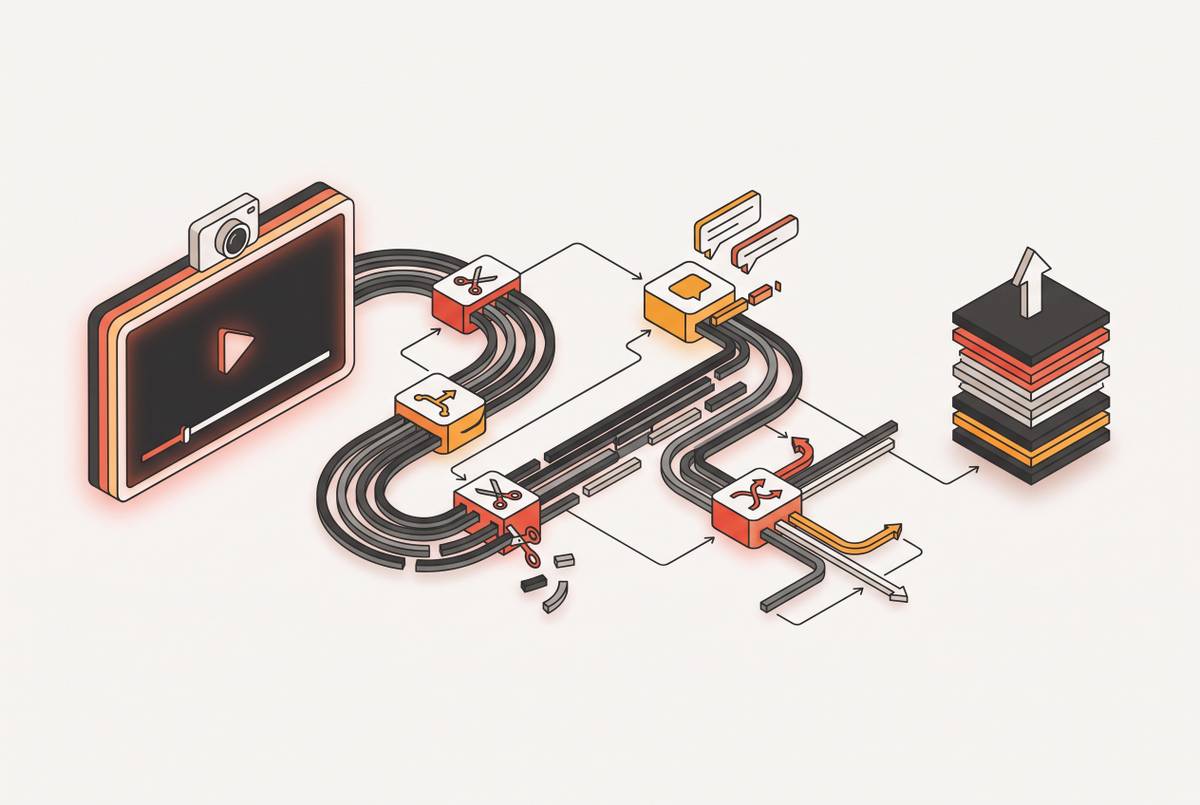
An index provides the evidence. The agent loop uses it to make and test a plan. The cycle has four stages, which are perceive, plan, act, and verify. During perception, the system builds a transcript, speaker map, scene index, and content-type profile from the footage. These become the basis for later decisions. Without that foundation, a natural-language instruction would have little to ground it beyond matching words.
During planning, the agent translates the brief into an ordered sequence of editing operations. It uses the index to determine which segments serve the stated goal, rather than assuming the shortest available version is the best one. The act stage executes cuts, captions, reframes, and audio adjustments against the timeline. That is the visible work of editing. But completing those operations is not enough to show that the resulting video fulfills the brief.
The verify stage checks the result against the goal, including caption sync, clip length limits, and narrative continuity, then folds feedback into another iteration. This is the decisive difference from basic automation. A completed cut is a technical event. A cut that preserves the explanation is an editorial result. Verification makes that distinction part of the process, although its success still depends on what the system can recognize and judge.
A micro-cut refinement agent uses ElevenLabs transcription to adjust boundaries at millisecond precision, preserving spoken content and key expressions. A beat-alignment agent uses music beat detection to change where cuts fall so they fit the rhythm and pacing. If alignment risks interrupting important narration, the beat-alignment agent aborts it. The music does not get to finish the speaker’s sentence.
Why Google's agentic inspection model changes the cost of semantic analysis at scale
Google’s agentic inspection model highlights a shift from processing a timeline uniformly to choosing where to inspect it. The governing principle is “watch less, understand more,” with inspection effort spent on signals likely to answer the question. Not every second deserves equal attention. For footage measured in hours, this changes the economics of gathering the evidence that a semantic model needs.
Static processing costs grow with duration even when the answer depends on a five-second event near the end. Selective inspection instead ties the work more closely to the complexity of the question. A narrow question can take less inspection effort than a broad narrative analysis of the same recording. Duration stops being the only driver. The shape of the task becomes part of the cost.
That shift makes archive search, long-form podcast editing, and multi-hour documentary rough cuts more feasible targets for semantic analysis where exhaustive processing was prohibitively expensive. Some questions still cost more to answer than others, and some answers are still more dependable. The benefit comes from selecting useful evidence. A question about an entire story can still require a broad view.
Finding the right footage is also different from producing the right edit. Retrieval locates a relevant passage. Production decides whether using it preserves the argument, maintains audio continuity, and respects the creative brief. A good timestamp is not a finished video. Lower inspection costs widen the material an agent can consider, but they do not settle the judgments needed to turn that material into a convincing sequence.
Where the semantic model reliably produces coherent cuts and where it still fails
Current agentic systems are most dependable on operations the index can directly ground. These include transcription, silence and filler removal, scene segmentation, speaker-based multicam switching, styled captions across many languages, highlight clipping, and platform-specific reframing. The work can be substantial. Finding a passage that fits the brief in a long interview and making it into a captioned clip takes more than spotting a quiet patch in the audio.
Ding et al. tested their system on 400+ long-form videos that included narrative films, conference keynotes, interviews, and sports broadcasts. The system produced complete edits end-to-end without human intervention, with assessment covering semantic fidelity, narrative coherence, and usability. That supports the case for autonomous production of complete edits. It does not establish that every creative decision was the best available one, or that review becomes unnecessary across other systems and tasks.
The VideoGAIA benchmark provides a useful check on broader claims of video understanding. It contains 271 human-verified tasks spanning six real-world categories, and all evaluated frontier models, including the strongest performer, achieved accuracies substantially below their scores on conventional video understanding benchmarks. Its main finding compares agentic multi-turn understanding with conventional single-turn understanding. It is not a direct measure of editing taste. Even so, it cautions against treating strong video recognition as proof that a system can reliably complete a complex chain of decisions.
An index can help propose which argument comes first, but it cannot reliably resolve that choice, select the best reading, locate every emotional beat, or establish whether a claim is true. Even silence removal exposes the gap. A system trained to maximize pace can systematically strip pauses with emotional weight, leaving a human to restore them. Mechanical competence and a recognizable personal voice are different achievements.
What can an AI video editor do without manual timeline work for product demos and async video?
For a non-editor making product demos, onboarding videos, or async updates, the largest burden is often deciding what to cut. It takes attention to search footage, find moments that help explain the point, and put them in order, even before timeline skill comes into play. The agent takes on that initial sorting. Its semantic index helps it propose a sequence, so the creator gets more than another set of tools to run.
A traditional assistive editor adds AI features to a timeline the human still runs, while an agentic editor lets the human do more of the directing, reviewing, and refining. Instructions such as “tighter cuts in the intro” or “find a better hook for clip two” express the desired result conversationally. No cut handle needs dragging. The distinction is whether the system chooses and revises operations from a goal.
Sequencing remains a shared responsibility because proposing an argument is easier than knowing which argument the creator wants to make. An agent can surface options, while the human makes creative decisions about story order and whether the result sounds like them. This is especially useful for a non-editor, who may know immediately that an explanation feels wrong without knowing how to rebuild it on a timeline.
For a SaaS team, the practical workflow is to record in one place, give a natural-language brief to trim, caption, and clip, then review story order and tone before sharing. The review is where the team checks the choices that the index cannot settle. The relevant criterion for an autonomous editor is therefore not just whether it makes cuts, but whether it plans from meaning, checks its work, and exposes decisions for review.
How can a small team automate editing without losing narrative structure or speaker intent?
The useful division of labor starts with a goal the agent can ground in the footage. “Turn this 40-minute demo into a three-minute highlight that shows the aha moment” gives the system a semantic target. “Cut from 3:20 to 4:10” bypasses that reasoning. Both request an edit, but only the first asks the agent to decide which material earns its place.
Review should then focus on the interpretable intermediates the best systems produce, including storyboards, narration scripts, and edit plans. Checking story order in a storyboard takes minutes and can catch flaws in how the story fits together before attention turns to tiny cut boundaries. Restore the beats that made the delivery feel considered. A video can be brisk without sounding as though the speaker is being charged by the breath.
Batch operations save the most work where there is least need for human judgment. Using the same brief for similar weekly demos, onboarding modules, or async updates lets the agent work through the files while the human checks a sample. The timeline can then be reserved for unresolved choices, including argument order, the best take of a sentence, and where an emotional arc lands. These choices take less time with a rough cut than with raw footage. The creators who benefit most are those who understand what the semantic model can and cannot hold.