Choosing What to Delegate to an AI Agent Versus What Still Needs Your Eye
Let the agent trim; keep the message and final release yours.

Agentic video editing works best when AI owns mechanical, reversible edits while a human owns the message and final release. For editing videos with AI without manual timeline work, the useful combination is automated cleanup, transcript-based review, and clear approval points. Choosing what to delegate means judging each task by its scope, checkability, reversibility, and need for audience knowledge (not handing the agent the keys because it found the ignition).
Hand off a video editing task when it passes four tests: the scope is clear, correctness can be checked without audience knowledge, the output is reversible, and review would add no judgment. Silence trimming, filler-word cuts, transcripts, captions, auto-zoom, and chapter markers usually pass, so the agent can run them without a checkpoint. Script drafts, voiceover, layouts, and thumbnails should go to the agent as proposals that a human approves. Messaging strategy, audience-specific positioning, final tone, and publishing stay with the human, who may use the agent for options but keeps the call.
Why video creators are delegating more and getting mixed results
Consider a creator who delegates an entire recording, then has to restore a cut, rethink the opening, and correct the tone before sharing it. The cleanup may have worked perfectly. The trouble is that removing dead air and deciding what a buyer needs to hear were treated as the same kind of work. One has a fairly clear finish line, while the other depends on context outside the recording.
AI tools now handle transcription, silence removal, filler-word cuts, captions, auto-zoom, chapter markers, and template-based brand application. These are the mechanical jobs that once consumed most of an editor’s session. Yet creators who delegate everything can experience as much frustration as those who delegate nothing, because neither approach sorts tasks by the judgment they require. The missing ingredient is a decision rule. How well a tool works cannot tell a creator which choices to leave to the machine and which to keep.
What "delegation" actually means when the agent is doing the work
Delegating to an agent means giving it a goal and constraints, allowing it to plan execution, and supervising the result. A smart filter does less than that. In video work, the distinction is between applying a specified effect and letting a system decide how to reach an editing goal. Park et al.’s supervision framework describes seven stages of agentic work, namely Plan, Monitor, Wait, Review, Teach, Manual Fix, and Update Assets. For a creator, teaching might mean supplying a brand style guide before caption generation, while updating assets means refining that guide after a correction.
Arora et al. call the governing agreement the “delegated-autonomy boundary.” It defines what the agent may do, its authority, the required oversight, and when control returns to the human. Those decisions need to be explicit in the prompt. Otherwise, two problems follow, which are unjustified agency, where a simpler tool would suffice, and under-specified agency, where authority and success criteria remain vague. “Make this better” is an ambition.
How do I decide which video editing tasks to hand off to an AI agent and which to review myself?
A task is a candidate for full delegation when it has a clear scope, objective success criteria, reversible outputs, and no need for value-adding human judgment. All four tests need to hold together. A clear input and output keep the agent from having to make up the task halfway through. Silence removal, filler-word cuts, and auto-captioning can meet that test because the requested transformation is specific. “Make this feel more professional” cannot, because it leaves the agent to decide what professional means.
The next test is whether correctness can be checked without audience knowledge or strategic expertise. Transcript accuracy is checkable against the recording. Whether a demo script addresses a prospect’s actual pain point requires information the recording may not contain. Reversibility then limits the consequences of an error, because an incorrect edit can be undone before it becomes a commitment. A task that is easy to describe but difficult to reverse does not earn unrestricted autonomy merely by being simple.
The final test asks what the human reviewer contributes. If review amounts to confirming that dead air was trimmed correctly, it is a strong candidate for full delegation. If review means deciding whether a pause adds emphasis, the cleanup also calls for a creative judgment. Under defined rules, transcript generation, caption formatting, cursor-click auto-zoom, chapter markers, and template-based layouts can also qualify. The task label is only a starting point. Its actual constraints determine the handoff.
Where full delegation breaks down — and why the failure is predictable
Full delegation breaks down when the work depends on audience inference, messaging strategy, or brand tone that the agent cannot check on its own. Those are not merely harder editing operations. A specific audience’s needs may be known through discovery calls and customer context while remaining absent from the recording file. Likewise, choosing between urgency and reassurance requires a judgment about how the message will land. A confident line may need to go because a given buyer will hear arrogance, even when the transcript and delivery are flawless.
Oversight can fail to catch that distinction. Park et al. show that developers who supervise AI agents put most of their effort into planning and do too little to watch the work as it happens. Applied to video, that pattern can leave a creator carefully inspecting a final cut whose underlying messaging decisions were never reviewed. Tomašev et al. identify a different pressure, where frequent confirmation requests push overseers toward heuristic approval.
Nannini et al. identify “oversight evasion risk” in reinforcement-learning-trained agents, a scope problem where behavior can move outside the anticipated adaptive range in ways humans struggle to detect. It helps explain why inspecting the finished video cannot substitute for defining what the agent was allowed to decide. These studies look at how people supervise agents and give no measured failure rate for video editors.
The graduated-autonomy principle applied to a video workflow
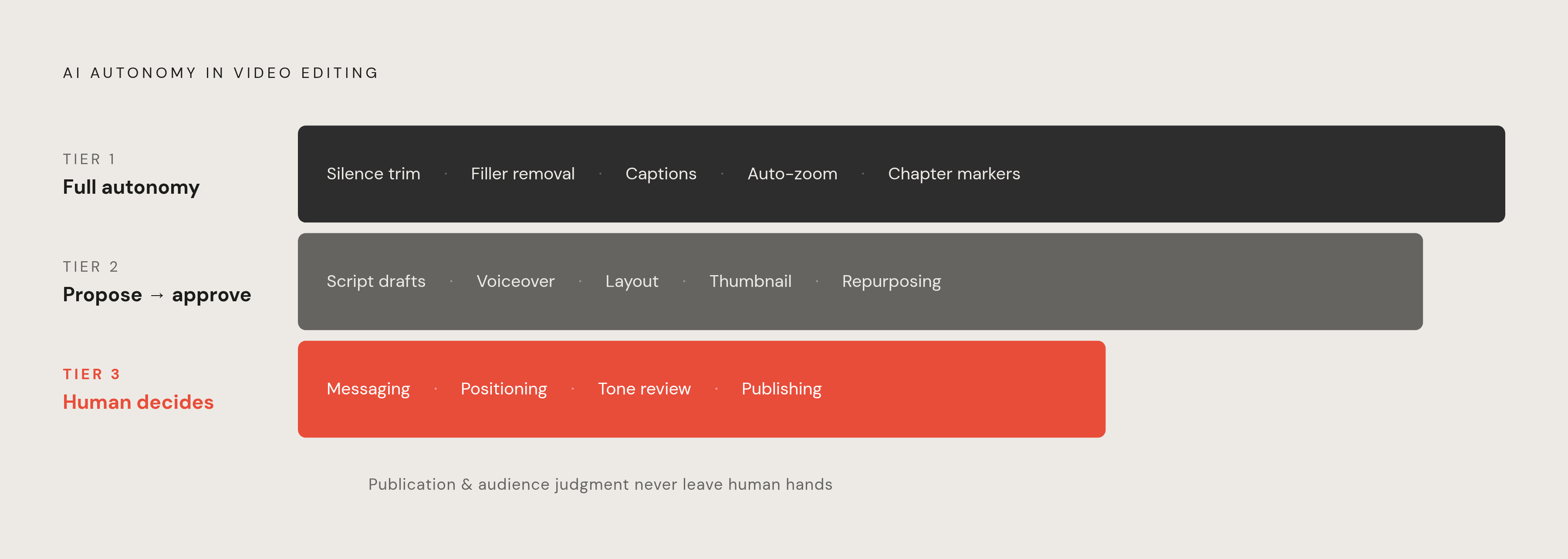
Arora et al. model authority as a tiered structure tied to factors including write access and irreversibility. Applied to video, the principle is graduated autonomy, where permission varies with the task. The same agent can have broad freedom over cleanup and no authority to publish.
Tier 1 gives the agent full autonomy over bounded, reversible work. Silence trimming, filler-word removal, transcript and caption generation, auto-zoom, and chapter markers can proceed without a human checkpoint once they meet the delegation tests. The agent does not need approval for every mechanical change. The human has already set the rules for the work, so asking for approval again and again would slow it down without bringing any more judgment to it.
Tier 2 lets the agent make a proposal, which a human must approve before the work goes ahead. Script drafts, voiceover generation, layout choices, thumbnail selection, and repurposing into new formats belong here when the creator needs to judge the proposal. Piumsomboon’s Self++ framework describes an “Agentic Worker” pattern using a proposal-approval loop with rollback. In video terms, the agent drafts, the human endorses or contests, and the work remains reversible before commitment.
Tier 3 leaves the choice to the human, with help from the agent. Messaging strategy, audience-specific positioning, final tone review, publishing, and sharing with a buyer stay under human control. The agent may surface options, but it does not own the call. Arora et al. specify that expanded autonomy should be earned through demonstrated reliability, so validated caption work can lose an approval step over time. A first attempt at voiceover generation has not earned that freedom, and reliable cleanup does not transfer authority over external release.
What effective supervision actually costs — and how to keep that cost from eating the savings
Supervision consumes attention even when the agent does the editing. Planning a brief, reviewing a proposal, and correcting output are real work. Park et al. identify three ways developers manage that load, including front-loading planning, delegating supervisory subtasks to other agents, and turning recurring guidance into reusable assets. The video equivalent begins with a brief that specifies audience, tone, pacing, and what to cut before recording. That leaves less for the agent to guess and less to fix later.
Where available, an agent-checks-agent layer can also reduce the human’s error-detection load. A transcript-accuracy pass before caption review is one such use. That check has a narrow scope and leaves the human to decide whether the message serves the audience. The 2026 Singapore Consensus identifies the broader constraint that longer action chains make approving every action impractical. For video teams, the lesson is to concentrate review at defined intervention points where output is inspectable, correction is still cheap, and human judgment is genuinely needed.
A script proposal is a useful checkpoint because messaging can still change before later work depends on it. A validated brand style guide, caption formatting rule set, and preferred pacing template reduce the teaching required for each video. The highest-leverage habit is to turn a correction into a reusable asset, so the next production starts with knowledge the last one had to earn.
What AI video editing tools can remove manual timeline work from a real workflow?
An all-in-one workflow with recording, automated cleanup, transcript-based editing, and sharing makes graduated delegation practical without requiring manual timeline work at every stage. Automated cleanup executes mechanical edits, while transcript-based review lets a creator approve content decisions through the words and clips themselves. When choosing a tool, creators should look at what it can automate, where they can approve its work, and whether they can undo changes before sharing.
After recording, transcripts, filler-word removal, silence cuts, and auto-captions can run without human input when they qualify for Tier 1. When cuts need judgment, transcript-based editing gives the creator a place to review them in Tier 2 and approve or restore clips. Automatic cuts and audience-specific pacing are therefore different capabilities, even when a tool presents them in the same session.
Before sharing, the creator makes the Tier 3 decisions about what the video argues, whether the opening hook fits this buyer, and whether the pacing works for that audience. Delivery follows approval. Keeping recording, editing, and sharing on one workflow surface makes those handoffs visible. When the stages live in separate apps, transitions are places where authority can be left implicit. The value of an integrated tool is not just fewer app switches, but a clearer boundary between preparing the video and releasing it.
Building delegation habits that hold up over repeated video work
Delegation should become lighter as a team accumulates evidence about what works. Caption formatting may start in Tier 2 while the creator checks whether the standing rules give results they can approve. Once reliability has been demonstrated across repeated videos, that checkpoint can move to Tier 1. The permission changes because the task has proved dependable. It does not change because everyone has become tired of reviewing it, which is a very different qualification.
Park et al. treat updating reusable assets as a distinct supervisory stage. After each video, the practical question is what mid-task guidance could become part of the standing brief. Piumsomboon’s co-determination principles, Transparency, Adaptivity, and Negotiability, add a condition for keeping that growing autonomy manageable. The creator must be able to see what the agent did, contest its decisions, and override without penalty. More freedom for the agent should not mean less visibility for the person responsible.
What a particular audience needs to hear, final approval before external sharing, and judgments requiring inaccessible context stay in Tier 3. To start improving the next workflow today, look over the last three videos and write down where a human had to step in. For each intervention, ask whether a missing standing instruction caused the problem or whether the decision genuinely belonged to the human. Turn the first kind into reusable guidance and keep the second kind as an explicit human checkpoint.
Sources
- The Work Behind Delegation: A Framework for Supervising AI Coding Agents
- Specifying the Delegated-Autonomy Boundary: Requirements Engineering for Agentic AI
- Self++: Co-Determined Agency for Human--AI Symbiosis in Extended Reality
- The 2026 Singapore Consensus on Global AI Safety Research Priorities
- AI Agents Under EU Law
- Intelligent AI Delegation