Prompt Engineering for Video Editing AI Agents
Structured prompts turn unreliable AI edits into repeatable workflows.

Agentic video editing uses AI agents to plan edits, find footage, and manage cuts and rendering from a brief, so the work does not need to be done by hand on a timeline. Prompt engineering makes it possible to repeat those decisions through the structure, context, and constraints in a prompt, with no need for magic words. For non-editors, the dependable workflow combines clear instructions, inherited decisions across steps, and human review where meaning matters.
Why AI video editing agents fail without structured prompts
The first edit looks fine, but the next try changes the pacing, loses a useful moment, or feels like a different video. Nothing has obviously broken, which makes the problem harder to diagnose. An acceptable result is not the same as a repeatable process. A colleague cannot reliably reproduce an edit when the instructions leave most of its decisions unstated.
A vague prompt forces the agent to fill those blanks with generic defaults. The research system from the University of British Columbia, University of Bristol, and University of Cambridge identifies weaknesses in timestamp reliability, character continuity, and causal grounding when narrative context is missing, even in recent large multimodal models including Gemini 2.5 Pro and GPT-4o. The output can look coherent while resting on a fragile understanding of the footage. More enthusiasm in the prompt does not repair that foundation.
The useful shift is toward technical orchestration, where the prompt functions as a director’s brief. It defines the decisions the system needs to make and the limits within which it can make them. Tella takes a related approach through sensible editing defaults in its interface, reducing the unspecified choices non-editors must navigate.
How agentic video editing systems actually work
An editing agent interprets a brief, plans across steps, and coordinates work, so describing the desired appearance is not enough. The system also needs to understand which parts of the footage serve the goal. A request for a short video leaves open what the video is supposed to accomplish.
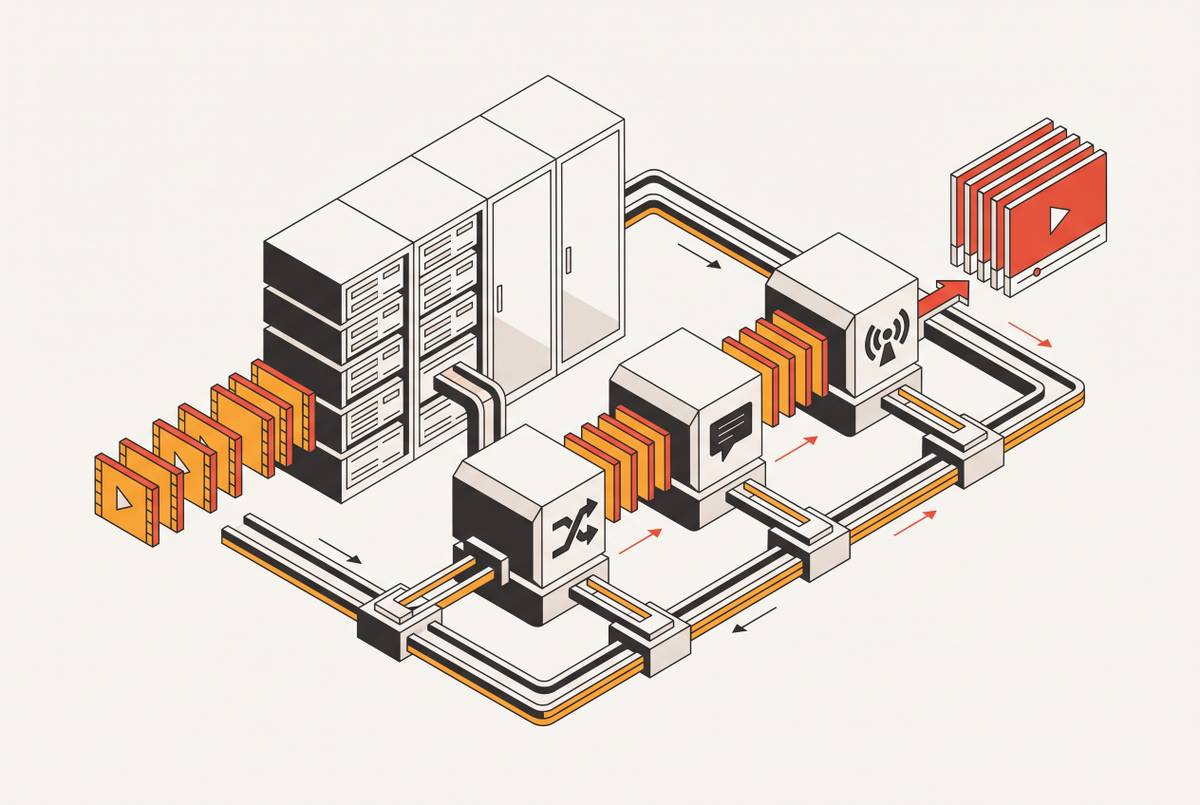
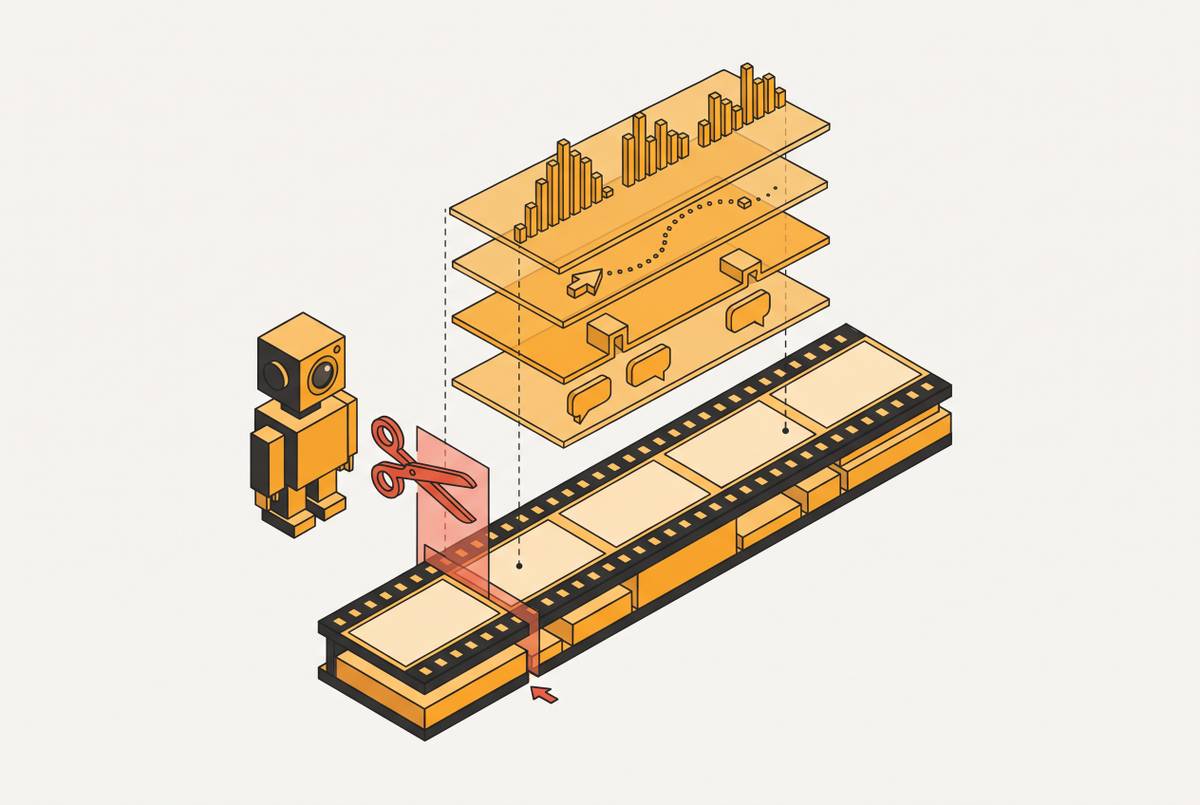
The University of British Columbia, University of Bristol, and University of Cambridge system makes this architecture concrete. Modular agents for planning, retrieval, and rendering work over a persistent semantic index. That index connects timestamped footage with plot points, character arcs, dialogue, emotional cues, and visual context. Its construction combines hierarchical temporal segmentation, guided scratchpadding with context compression, and cross-granularity fusion. In everyday terms, the system organizes events at different scales and connects the summaries to specific moments.
This shared model of the content lets the system turn a goal into a plan, storyboard, narration script, edit plan, and finished video. A broad request such as “Summarize this lecture as a 3-minute explainer” gives it room to choose the material. A constraint such as excluding a character narrows what it may retrieve and use. The research system was evaluated on more than 400 long-form videos, including narrative films, conference keynotes, interviews, and sports broadcasts.
The hinge for prompting is the distinction between what the footage contains and what the creator intends. An agent can identify visual events, transcript text, and rough timing, but those do not establish the intended audience, emotional arc, exclusions, brand constraints, or output format. The prompt supplies that missing frame and guides how the content model becomes an edit. Even when an everyday creator uses a built-in editor such as Tella’s, the narrative context must come from the creator.
The structural anatomy of a prompt that gives an agent enough to work with
Compare “edit this product walkthrough into a 90-second summary” with a more complete brief. The first request supplies a source and a duration, but little basis for choosing between useful moments. It does not say who needs the summary or what they should see first. The agent has permission to guess, even if the creator did not mean to grant it.
The stronger version reads “edit this product walkthrough into a 90-second summary for a first-time SaaS user; open on the moment the dashboard loads; cut filler words and pauses; close on the share button interaction; tone is confident and unhurried; add captions timed to speech rhythm”. The audience now gives the selection a purpose, while the opening and closing interactions define its boundaries. The pacing instruction says what to cut, and the tone sets how forceful those cuts should feel. Captions become part of the intended viewing experience.
A complete brief covers the decisions relevant to the job, including subject or scene, emotion arc, optics and framing, camera motion, lighting, style and look, audio, and continuity anchors. These decisions need to be resolved wherever the workflow calls for them, especially when it includes generated shots. When a choice is left out, the agent usually falls back on a default such as a static medium shot or no clear audio intent, without showing an error message. In all-in-one tools, well-chosen presets for audio levels, caption styling, and color grading also leave fewer choices for the agent to fill in.
Continuity anchors need extra care because clips can look good on their own yet fail to fit together. Seeds, style tokens, and palette references give later shots something specific to inherit, although no platform solves multi-shot consistency automatically. Negative prompts establish the other boundary by specifying what must not appear. A small set of focused exclusions can suppress common artifacts without burying the brief in prohibitions.
Prompt chaining as the mechanism for repeatable, multi-step edits
Continuity anchors help more when they carry through a series of steps than when they stay in one prompt. Prompt chaining carries decisions from one step into the next. A creative brief becomes a beat sheet, the beat sheet becomes a shot list, and the shot list goes into the prompts that make the edit.
The important inheritance is not only visual. In the university research system, planning, retrieval, and rendering agents operate over the same semantic index, so a planning constraint can govern later work. If the brief excludes Character A, retrieval and rendering inherit that exclusion. The same workflow principle applies to keeping an audience, tone, and ending in view throughout an edit.
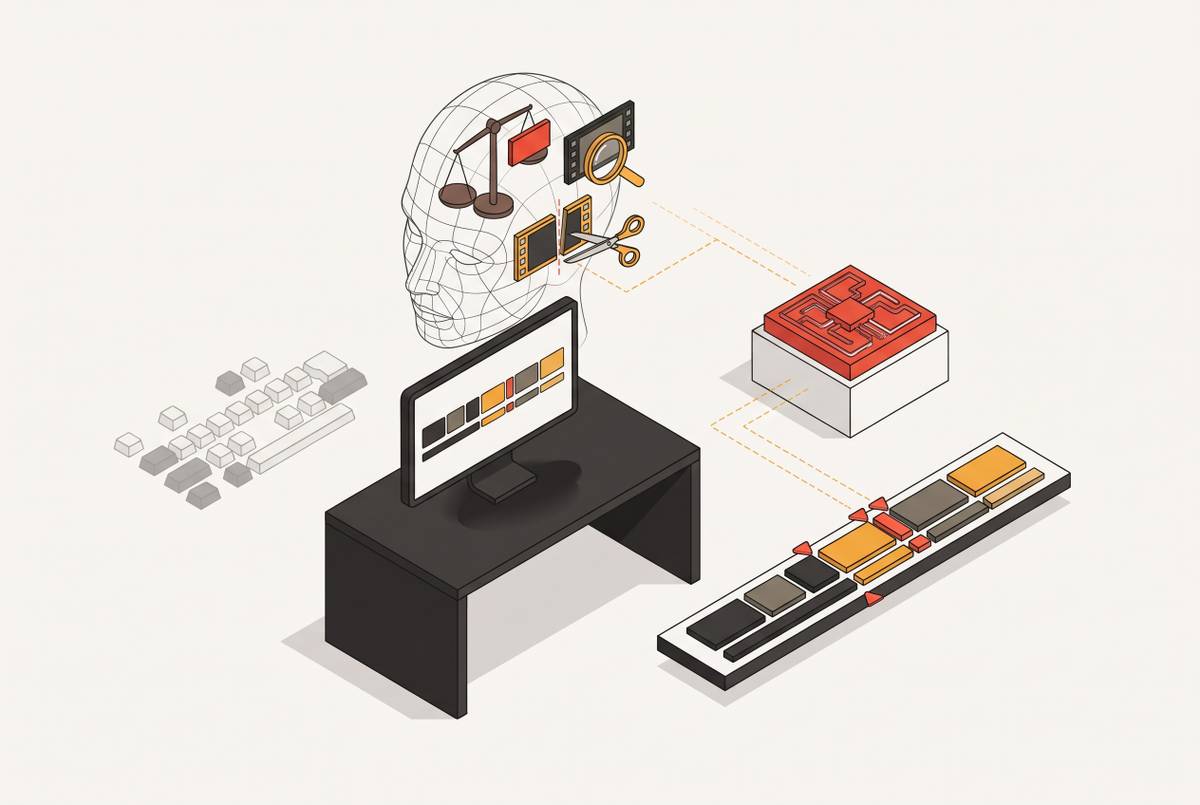
That connection also creates its strongest risk. A wrong choice early in the chain can compound through every later step, producing a polished answer to the wrong brief. Human checkpoints interrupt that cascade. Interpretable intermediate outputs, including storyboards, narration scripts, and edit plans, give the creator something concrete to review before allowing the work to proceed. The “AI-first, human-polish” pattern keeps mechanical steps with the system and judgment at defined gates.
For a non-editor, this shifts the focus of review from what to cut to whether the output matches the previous brief. That is a narrower question with a traceable answer. Documented, versioned prompts make it possible to locate and correct a faulty step while preserving the rest of the job. The reusable asset is therefore the sequence.
Matching prompt style to what each model is actually good at
Which AI tool can edit a video without manual timeline work depends on the work being delegated. Editing existing footage, generating a new shot, and preserving a visual world across scenes are different jobs. A structured prompt does not erase those differences. Comparing what the tools can do helps more than picking one winner for all time.
OpenAI Sora 2 is strongest for physics-dependent shots and longer single clips. Its “Characters” feature allows verified users to place their own consented likeness, or that of approved contacts, into synthetic environments, while arbitrary real-world human face uploads are blocked by policy. Runway Gen-4 focuses on “world consistency”, making it suited to image-to-video work that needs coherent characters, objects, and environments across scenes. Google Veo 3.1 offers enhanced narrative control and stronger prompt adherence, with reference image input, scene extension, and first-and-last-frame control. Those features matter when a workflow requires more control over how generated scenes connect.
For editing recorded material through intent rather than generation syntax, Tella offers a different profile. Its Tella Agent Beta is an AI editor in the sidebar that makes edits from a chat, within a recording, editing, and sharing workflow. That is a different proposition from choosing a generation engine for a physics-dependent shot. The buying criterion is whether the tool handles the decisions in the actual job.
Vocabulary then becomes the calibration layer. “85mm prime, f/1.4, shallow depth of field” directs a generation model differently from “close-up shot”, while a precise dolly-in speed is more useful than “moving camera”. Explicit changes in expression give clearer direction than an adjective such as “happy”. Prompt templates and optimization layers can translate intent into that technical syntax. Non-editors need to know which decision they want made.
Where AI editing agents handle repetitive decisions well and where human judgment still decides
Structured prompting works best on repeated mechanical choices with clear criteria. Agents can detect highlight moments, remove silences and filler words, generate captions, identify promising clip candidates, and apply consistent color grades across a series. These tasks provide a useful boundary for automation because the desired operation can be stated plainly. Asking a system to remove filler words is more definite than asking it to make an interview compelling.
Transcript-based removal makes that advantage concrete. Instead of scrubbing through a timeline to locate each filler word and silence, the agent can work from the transcript and its timing. Caption work follows the same logic, but its purpose extends beyond transcription. A brief can specify timing that follows speech rhythm and styling that matches the video’s emotional register.
The limit appears when a technically removable moment is narratively essential. The best part of an interview may be the pause before the answer, which a blanket silence-removal instruction treats as waste. Agents do not reliably reproduce human judgment about subtext, meaning, or the cut that changes a viewer’s interpretation. Anything past a few minutes of intended output needs a scripted or structured brief to support coherence. The human therefore decides what the video needs to do and which moments carry its meaning, while the agent executes the repeatable steps.
Building a prompt library that makes the workflow repeatable for a team
A team producing weekly videos needs those decisions to survive a hand-off. A shared prompt library provides templates for recurring formats, including product demos, async updates, customer stories, and onboarding modules. Each template carries the structure, tone, caption style, pacing defaults, exclusion rules, and output format. The creator supplies the particular content, the audience for that instance, and any one-off constraints.
Tracking which prompt variant produced which output gives the team a basis for comparison and a way to roll back changes. It also helps catch prompt drift, where model updates degrade a previously reliable style. A prompt version preserves the instructions associated with earlier results. Without that record, diagnosing a changed output becomes guesswork about yesterday’s guesswork.
For a weekly series, the practical value is maintaining a visual style without rebuilding the brief each time. Recording, editing, and sharing in one workflow, as Tella supports, fits this recurring production pattern by reducing the need to switch environments. The prompt library remains the shared record of what the team wants, regardless of which tool executes the work. Its value comes from documented decisions rather than the memory of the person who last made a good video.
A well-maintained library also records where automation stops. Review gates set out which choices a person needs to make and why, so a pause that carries meaning stays in even when the template usually removes silence. Those boundaries make the workflow easier to trust because its limits are explicit. Structured prompting makes AI video editing reproducible not by eliminating judgment, but by making both delegated decisions and human decisions visible and intentional.