Agentic B-Roll Insertion in Screen Recording Workflows
AI agents split editorial decisions about where B-roll goes, not just executing one task.
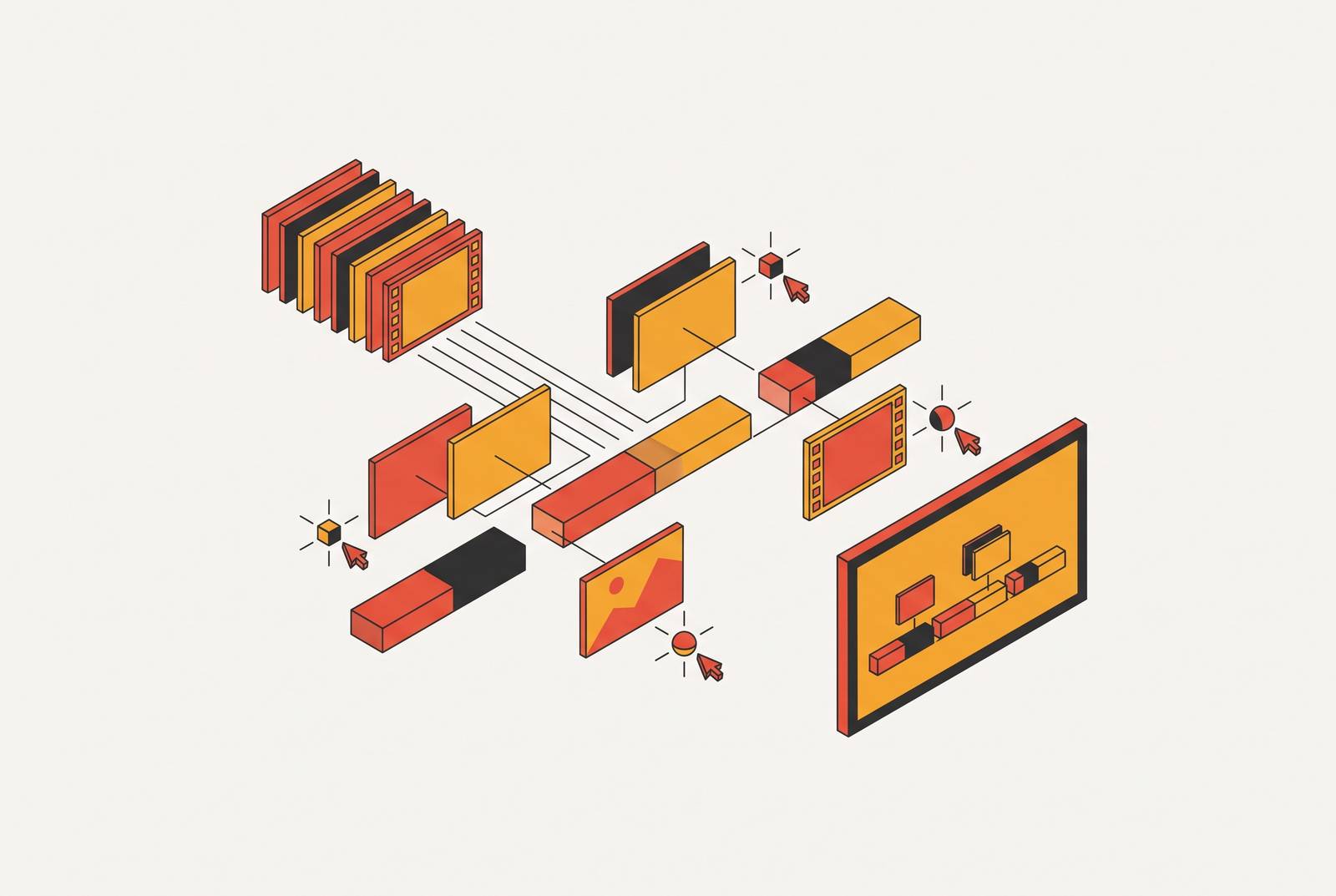
Agentic B-roll insertion is a system of AI agents dividing up editorial judgment, not a single model guessing which clip goes where. That distinction is the whole article: old AI editing tools finished tasks, and agentic systems make decisions.
What agentic B-roll insertion is
Old-school AI editing worked like a vending machine. You put in a task, like silence removal or caption generation or a rough cut, and one model handed back one output. Simple, predictable, and about as creative as a toaster.
Agentic systems don't work that way. Instead of one task and one model, several agents split the job and keep talking to each other about it. A research agent reads the transcript, trends, keywords, and competitor content. A narrative agent takes that material and rebuilds it into an arc designed to hold attention. A sequencing agent trims the dead air, cuts the repeats, drops in B-roll at the spots the narrative agent flagged, and adjusts the pacing. None of them clock out after their turn. They loop back, check results against retention signals, and adjust again.
That loop is the real upgrade. A vending machine doesn't learn from the last snack you bought, but this system does, and it starts anticipating what a video needs instead of just reacting to a transcript line by line.
The practical result: the question changes. It's no longer "which clip fits here?" The system is now asking "why does this moment need visual reinforcement at all?" That's a judgment call, not a lookup. And once a machine is making judgment calls, the next fair question is what logic it's actually running on.
How the multi-agent pipeline reasons toward a B-roll decision
The logic runs on several signals at once, not one model pattern-matching a keyword against a stock library.
The research agent starts with the transcript. It hunts for narrative anchors, dense clusters of meaning, and keyword patterns that mark the spots where a viewer is likely to lose the thread without something to look at. Think of it as a highlighter pass, except the highlighter also takes notes on why each line matters.
The narrative agent takes those notes and decides which beats actually carry the argument forward and which are exposition, the connective tissue that needs a visual to keep someone from tuning out. Every explainer video has a stretch like this: necessary, but not thrilling on its own.
The sequencing agent does the physical work. It trims silence, cuts redundant lines, inserts B-roll exactly where the narrative agent pointed, and adjusts visual rhythm so cuts don't feel jarring. Then it sends everything back into the loop so the system can check whether those choices actually held attention.
Vision models spot scene boundaries and emotional cues, language models parse semantic structure, and audio models judge tone and clarity. A supervisory controller sits above the three of them, resolving disagreements and ranking which edit candidates move forward. The coordination between them is.
Sourcing splits the work two ways from there. One path transcribes the audio and pulls matching clips from stock libraries based on keyword or semantic overlap. The other is generative: when no stock clip exists for the shot the script describes, a model creates one from scratch. That generative option determines how screen recording teams should think about sourcing, and it gets its own full treatment later in this piece.
What agentic systems can and cannot reliably judge in screen recordings
The pipeline described above is genuinely good at structure. It is not good at knowing whether a moment actually lands.
On the reliable side: rough cuts and assembly following pacing rules, captions, silence and filler removal, color correction, reformatting for different aspect ratios, and B-roll insertion driven by keyword matching. Hand the system a transcript and it will give you something watchable back, fast.
On the side that still needs a human: story arc and pacing judgment (the system can follow a rule about where a cut should go, but it can't tell you whether that cut feels right), brand voice, music selection and timing at a professional level, and motion graphics that go beyond a template. Eddie AI's own CEO, describing version 4 at IBC 2026, said the output gets a project "to a fine cut rather than leaving it at a rough cut." That's a real improvement over earlier tools, and it's also an honest admission that a fine cut still isn't a finished product. Something between automation and judgment is still missing, and that gap has a name: a human editor.
Screen recordings add a wrinkle the general case doesn't have. A sequencing agent optimizing for generic retention signals doesn't know it's looking at a product demo. It might swap in a lifestyle cutaway, people laughing around a laptop, hands typing on a keyboard that isn't the actual software, at the exact moment a viewer needs to see the real interface. That substitution breaks the implicit deal a product demo makes with its audience: show the thing, not a stand-in for the thing. A general retention model has no way of knowing that rule exists.
The stock-library problem and generative B-roll
Keyword-matched stock footage has a sameness problem, and it appears across the entire category of agentic video output. When every agent pulls from the same handful of stock libraries using the same keyword logic, every video starts looking like it was edited by the same person, because in a sense, it was. Picture ten different companies all searching "team collaboration" and all getting the same three people high-fiving over a laptop. Multiplied across thousands of videos, this flattens brand identity across the category.
Generative B-roll is a real counterweight to that problem, not a cure-all, and the practitioners getting this right are running hybrid workflows, combining generated clips, traditional stock, and real filmed footage, because leaning on any single source too hard just trades one flavor of sameness for another.
A tiered approach is forming out of that mix. Stock footage covers general concepts and cuts that just need generic visual texture. Generative clips fill in shots that don't exist in any library (the specific, odd visual a script calls for that nobody has ever filmed). And actual screen recordings handle the moments where authenticity is the whole point, the software itself, doing the thing it does.
For screen recording teams, that third tier carries the most weight by a wide margin. A viewer watching a product demo wants to see the product. No stock clip and no generated frame can substitute for that, because the moment's value depends on the viewer seeing the actual product. Generative B-roll fills the gaps where stock footage can't match every shot a script calls for.
The trust penalty for AI-visible B-roll
Viewers who clock a piece of B-roll as AI-made trust the brand behind it less, even when nothing else about the video changed. That's not a guess. Research on AI-mediated video found that perceived trust and confidence dropped in AI-mediated videos, especially when the AI involvement was made obvious in settings where some participants used avatars and others didn't.
The same research found that people's actual judgment accuracy stayed the same, and they were no more likely to suspect the speaker of lying. The damage lands on brand impression. It doesn't touch how well someone can actually evaluate what they're watching. That's a narrower problem than it first sounds, and a more fixable one.
Screen recordings have an advantage baked in for this reason. A slightly rough screen recording, cursor jitter and all, reads as more trustworthy than a glossy video stitched together with recognizably AI-sourced B-roll. The rough edges signal a real human clicking through real software in real time. Polish, ironically, can read as a tell.
The stakes rise even further in instructional content. When a learner can't tell whether they're watching a real expert or an AI stand-in, the question becomes whether the teacher is even real, not just whether the production quality holds up. Screen recordings don't erase that problem outright, but they shrink it, because the viewer is watching the actual product do the actual thing, not a visual stand-in meant to represent it.
The design implication follows directly: screen recordings should be the default B-roll source for anything product-specific, with stock and generative sources held in reserve for concept coverage where no real UI footage exists. The sequencing agent's insertion logic needs that hierarchy built in. Keyword density alone won't protect it.
Human review placement in an agentic B-roll pipeline
Human review works best at two checkpoints: before the pipeline runs, and right before it ships. Spreading review across every single cut defeats the purpose of automating anything.
The first checkpoint is objective-setting. Before the agents touch the footage, a human decides which moments require a real screen recording, which can tolerate stock footage, and which can lean on generated visuals. That decision gives the sequencing agent an actual sourcing hierarchy to follow instead of leaving it to match keywords against whatever's in the library.
The second checkpoint is the authenticity gate: one pass, at the end, asking a single question. Does any inserted clip replace a moment where the audience needed to see the real interface? If yes, swap in the matching screen recording segment. That's a fast check on a finished draft, not a teardown and rebuild.
Quality gates placed at these two points let teams tighten their automated thresholds over time. Review then shrinks to spot-checking batches.
For SaaS product demos specifically, a few rules of thumb hold up at scale. Keep it short: feature announcements shorter than sales demos, sales demos shorter than support walkthroughs. Put the value proposition up front. And treat automatic cursor zoom as close to non-negotiable for anything UI-heavy, because a recorder that handles cursor-aware framing live, while recording, removes the single biggest bottleneck agentic systems still handle clumsily after the fact.
Mosaic's A/B testing feature fits neatly into this review structure. It runs multiple prompt variants against the same raw footage, letting a team test different prompts, models, and workflows side by side before locking in a final cut. That's a structured way to check whether the agent's B-roll choices are actually serving the trust needs of the video before it's published.
Using agentic B-roll systems with intention rather than accepting their defaults
The teams getting real value from these pipelines aren't the ones who hit run and walk away. They treat every agent decision as a hypothesis, a first guess about what a given moment needs, and then confirm or override it based on what the video actually has to accomplish.
That shift changes the editor's job description. Instead of cutting a timeline by hand, the human sets the objective, lets the agent network do the execution, and then checks the result against that objective. It's a different skill than timeline editing. It is not a lesser one, and treating it that way is how teams end up with a pile of forgettable videos that all technically got made.
Knowing how the pipeline reasons is what makes that supervision possible. It's just understanding the tool well enough to aim it, not a workaround.
As agentic B-roll insertion becomes a standard feature rather than a novelty, the edge stops coming from who edits fastest. It comes from who understands why a given moment needs visual reinforcement in the first place, and who can tell the agent that reason clearly enough to act on it. Speed is table stakes now. Judgment is what separates a team making distinctive video from a team making a lot of it.